
The Short Answer
A mandatory reconsideration notice is the DWP letter that ends a PIP reconsideration, stating whether the decision changed and why; the request behind it is due within 1 month of the decision letter. The reconsideration itself can be asked for by phone, by letter or on the CRMR1 form, and a request that names the activities scored wrongly, and why, gives the decision maker something specific to check. The notice is the document a tribunal appeal requires.
How to Ask
Three routes, one deadline, and a short list of required details. GOV.UK sets out what to include: the date of the decision, your name and address, your date of birth, your National Insurance number, and why you think the decision is wrong.
| Route | Detail |
|---|---|
| Phone | The number on your decision letter, or the PIP enquiry line on 0800 121 4433, Monday to Friday, 9am to 5pm |
| Letter | To the address on the decision letter, keeping a copy |
| Form | Form CRMR1 from GOV.UK, sent with any new evidence to the address at the top of the decision letter |
Last checked:
A phone request is recorded and counts, but a written request creates a record you hold as well. Where the deadline is close, phoning first and writing afterwards protects both the date and the detail. GOV.UK adds: "If you're writing, the letter or form must arrive by then."
What to Put in the Request
The activity, the descriptor, the frequency, and the evidence. A reconsideration that repeats the original claim asks a different person to reach a different answer on identical papers.
Work from the points section of the decision letter, which names the descriptor chosen for each of the twelve activities. For each one you disagree with, write four things:
- The activity and the descriptor you say applies, quoted.
- What happens when you attempt the task, including what follows it.
- How many days a week the difficulty arises, because the test is more than half.
- The document that supports it, enclosed as a copy.
Two or three activities addressed properly is stronger than twelve addressed briefly. Where the assessment report records something inaccurate, say what was actually said. On evidence, GOV.UK asks for "evidence you have not already sent", and says to "Write your full name, date of birth and National Insurance number at the top of each bit of evidence".
Last checked:
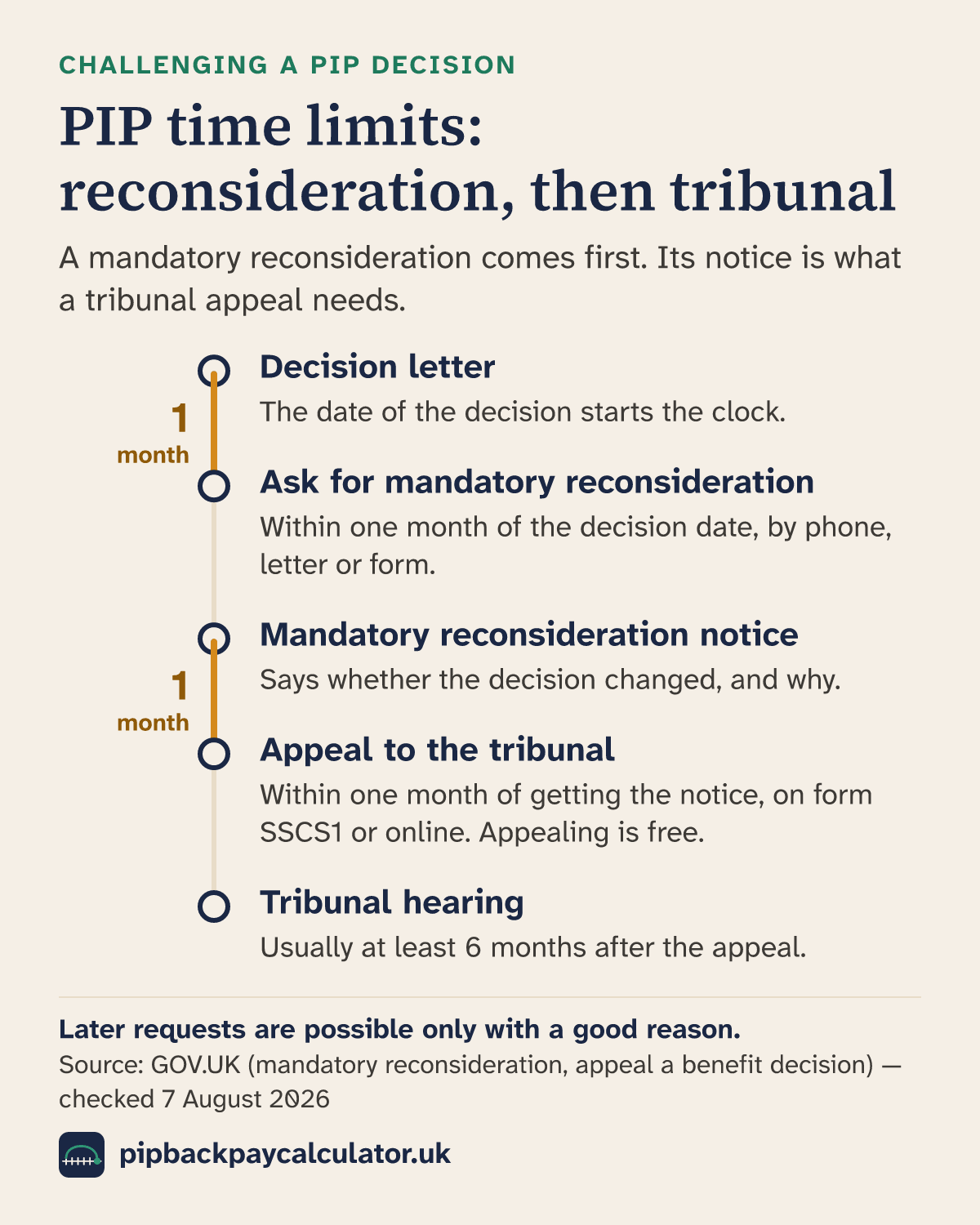
A PIP decision is challenged by asking for a mandatory reconsideration within one month of the decision date, then appealing to a tribunal within one month of getting the reconsideration notice.
Last checked:
What Is the CRMR1 Form?
CRMR1 is the DWP's mandatory reconsideration request form: you download it from GOV.UK, fill it in on screen, print it and post it. GOV.UK states: "Send your completed form and any relevant evidence to the address at the top of your decision letter."
A notes leaflet, CRMR1A, explains how to disagree with a DWP decision, and GOV.UK records the form as last updated on 20 January 2026. The form is one route rather than a requirement. A letter that carries the same details, dated and signed, is an accepted alternative, and a phone call counts as well.
Last checked:
Can You Ask for a Mandatory Reconsideration by Phone?
Yes: GOV.UK lists phone as one of the ways to ask, alongside a letter and the CRMR1 form. The fourth route GOV.UK names, the Universal Credit journal, applies only to Universal Credit decisions.
For PIP, call the number on your decision letter or the PIP enquiry line on 0800 121 4433, Monday to Friday, 9am to 5pm. Note the date, the time and the adviser's first name. Where you have evidence to send, follow the call with a letter that says the request was made by phone on that date, with the evidence attached.
Last checked:
What If You Are Past the One-Month Limit?
You can still ask, but the request needs a good reason and the DWP decides whether to accept it. GOV.UK states: "You can ask for it after one month if you have a good reason, for example if you've been in hospital or had a bereavement."
The outer limit is set by regulation 6 of the Universal Credit, Personal Independence Payment, Jobseeker's Allowance and Employment and Support Allowance (Decisions and Appeals) Regulations 2013. A late application must be made "within 12 months of the latest date by which the application for revision should have been received", which puts the last possible date 13 months after the decision letter. The longer the delay, the stronger the reason has to be.
State the reason and the dates in the request itself, rather than in a later letter.
Last checked:
What Happens Next
A different decision maker reviews the decision, the evidence and anything new. They can increase the award, leave it unchanged, or — rarely — reduce it. The possibility of a reduction is worth knowing about before requesting, though it is not the usual outcome.
Decision letter
Its date starts the clock for a challenge.
Deadline: Ask within one month of the decision
Mandatory reconsideration (this page)
A different DWP decision maker looks again; you can still ask after one month if you have a good reason.
Mandatory reconsideration notice
States whether the decision changed, with the reasons. The tribunal needs it.
Deadline: Appeal within one month of the notice
Appeal to the tribunal
Free to appeal a benefit decision; submitted online or by post on form SSCS1.
Typical wait: Hearing usually at least 6 months later
Tribunal hearing
An independent panel decides; the decision can come on the day.
Typical wait: Money normally 4 to 6 weeks after a win
Back pay and new award
One lump sum backdated to the claim, then regular payments at the new rate.
Last checked:
Source: GOV.UK, Mandatory reconsideration and Appeal a benefit decision; Citizens Advice
How Long a Mandatory Reconsideration Takes
The DWP's median clearance time was 45 calendar days for new claims and 46 for DLA reassessments in July 2026. Its PIP statistics, published on 15 September 2026, state: "In July 2026, the median MR clearance time was 45 and 46 calendar days for new claims and DLA reassessments, an increase of 2 days respectively in relation to the last quarter."
Last checked:
No regulation sets a deadline for the decision. A median is the middle case, so about half of reconsiderations take longer than that figure. Where a request has been open well beyond it, the PIP enquiry line can confirm whether a decision has been made and when the notice was sent.
The Mandatory Reconsideration Notice Explained
A mandatory reconsideration notice is the DWP letter that ends a reconsideration, stating whether the decision changed and the reasons and evidence behind the outcome. GOV.UK describes it as the letter "stating whether the decision changed and the reasons/evidence".
Keep the original. The tribunal asks for it: GOV.UK lists "your mandatory reconsideration notice" among what an appeal needs, and the one-month limit for appealing runs from the notice rather than from the first decision letter.
How Often It Changes the Award
26% of reconsiderations cleared in the quarter ending July 2026 changed the award, excluding withdrawn ones. Over the five years from August 2021 to July 2026, 27% of the 1.4 million reconsiderations cleared led to a change in award, and for initial decisions made between April 2021 and March 2026, 15% of completed reconsiderations did.
Last checked:
All three figures come from the DWP's own quarterly PIP statistics. They describe outcomes across a population rather than odds in a particular case, and the difference between them mostly reflects the period and population each covers.
Where the reconsideration does not change the decision, that is not the end of the route. For initial decisions made between April 2021 and March 2026, 35% of completed reconsiderations went on to lodge an appeal, and 17% of appeals lodged were "lapsed" — the DWP changing its own decision in the claimant's favour before the hearing.
If It Succeeds
The new decision replaces the original from the date the original took effect. Every week in between is repriced, and the difference is paid as one lump sum.
Payment normally follows within days, because a reconsideration is decided inside the DWP and the payment instruction issues from the same system. What the arrears cover for each kind of original decision is set out on the Back Pay After Mandatory Reconsideration page.
If It Does Not
One month from the notice to appeal to the tribunal, and it is free. The appeal is submitted online or on form SSCS1, with the mandatory reconsideration notice attached.
The tribunal is independent of the DWP, and a different body reaching a different conclusion is the ordinary case rather than an exception: for initial decisions made between April 2021 and March 2026, 65% of DWP decisions cleared at a hearing were overturned. The whole route, with its deadlines, is on the challenging decisions page.
Last checked:
Related guidance: MR Success Rates.