
The Short Answer
PIP back pay normally arrives within days of an ordinary decision, and within 4 to 6 weeks of a tribunal decision. The money comes as one lump sum, separate from your first regular payment. The wait depends on the trigger: awards the DWP makes itself pay fastest, awards a tribunal makes travel back to the DWP first. Whatever the wait, the amount is protected back to your claim date.
How long does PIP back pay take?
Each trigger has its own normal timescale, and the differences come from who makes the decision. The rules and triggers decide the owed-from date; the table below adds the waiting time for the money itself.
| Trigger | Decision made by | Money normally arrives |
|---|---|---|
| New claim awarded | DWP decision maker | Within days of the decision |
| Mandatory reconsideration success | DWP decision maker | Within days of the new decision |
| Tribunal win | Independent tribunal | Normally 4 to 6 weeks after the decision |
| Review or reported change | DWP decision maker | With the first recalculated payment |
Last checked:
The pattern in the table is simple: a decision made inside the DWP starts payment directly, while a tribunal decision adds a return journey. Nothing in the wait changes the amount, which accrues week by week until it is paid, and the arrival norms hold in 2026 exactly as they have in recent years.
The tribunal row is the only one with a published range: Citizens Advice puts it at 4 to 6 weeks from the decision, and the full sequence is set out in PIP Back Pay After Winning a Tribunal. A reconsideration follows the DWP route, covered in back pay timing after mandatory reconsideration.
How long after being awarded PIP do you get back pay?
Within days, and often before the decision letter. Payment instructions move faster than post, so an unexplained DWP deposit after your assessment is normally your back pay. The letter that follows breaks the amount down and gives the date of your first regular payment; what the deposit can tell you before then is covered in back pay timing before the letter.
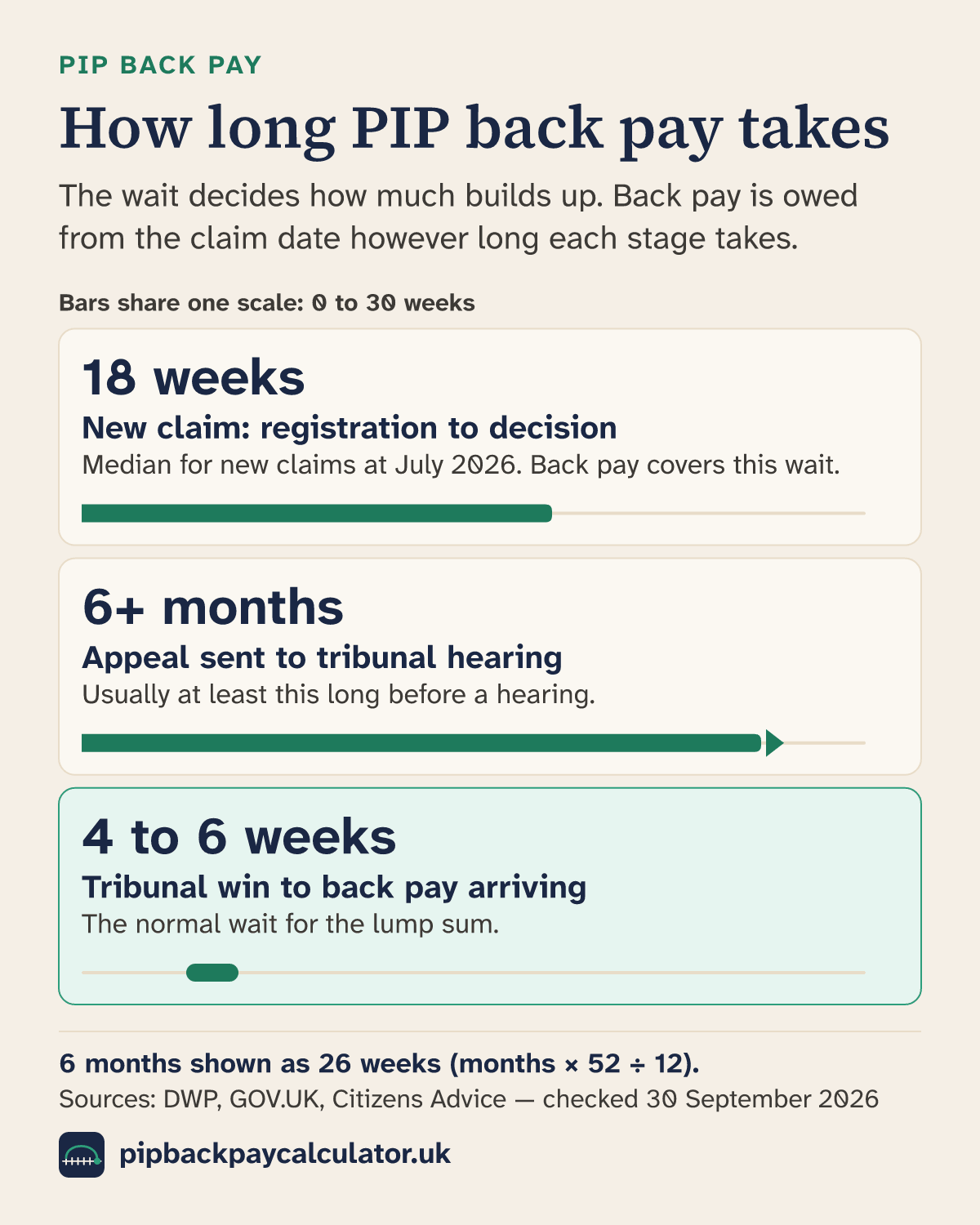
A new PIP claim took a median of 18 weeks from registration to decision at July 2026, a tribunal hearing usually takes at least 6 months, and back pay after a tribunal win normally arrives within 4 to 6 weeks.
Last checked:
Back Pay Timing in Detail
Late payment has a small number of common causes, and each has a next step. Work through them in order rather than waiting indefinitely.
- Confirm the decision date. Timescales run from the decision, not the hearing listing or the assessment.
- Allow the normal window: a week for an ordinary decision, six weeks for a tribunal decision.
- Call the PIP enquiry line on 0800 121 4433 (Monday to Friday, 9am to 5pm) and ask when payment was issued and to which account.
- Escalate a stuck payment through a welfare rights adviser or Citizens Advice if calling does not move it.
Last checked:
A large multi-year lump sum can need manual recalculation, which explains most waits at the top of the normal range. A payment that has been issued but has not appeared in your account within a few working days is a bank-detail question, and the enquiry line resolves those directly.
The waiting weeks are never lost money. However long processing takes, the sum keeps accruing from your claim date at the rates in force each year, exactly as the trigger table above prices it.
Why the routes run at different speeds
The speed differences in the trigger table have mechanical causes, not priority rules. An ordinary decision and its payment instruction come from the same DWP system, so nothing travels between organisations. A tribunal decision crosses from the courts service to the DWP and then through manual implementation, which is where the 4 to 6 weeks lives. Review recalculations sit between the two because an existing payment cycle already carries the claimant, and the recalculated amount joins it.
Size adds a second axis. Back pay inside one benefit year computes automatically; a sum spanning three years with an award change in the middle needs a person to assemble the segments. The large, old, complicated windows that produce the biggest sums are the same windows most likely to touch the top of the normal range.
What arrives first, and in what order
Multiple payments follow one decision, and their order confuses more claimants than their timing. The lump sum normally arrives first, as a standalone transfer. The first regular 4-weekly payment follows on the date the decision letter sets. Where a tribunal increased an existing award, the ongoing payments simply rise from the next cycle, and the difference for past weeks arrives as its own transfer alongside.
A missing letter changes none of this. Payments run from the decision, not from your reading of it, and a replacement letter is one enquiry-line call away. The only genuinely wrong order is money that stops: an existing award should keep paying at the old rate throughout any recalculation, and a halted cycle is itself worth reporting the week it happens.
Every timescale above describes the normal case, and normal covers most claims most of the time.
Work Out Your Number
While you wait, put your dates and award into the estimate and see what should be coming: pip back pay explained, worked out for your own case.