
The Short Answer
The DWP's latest published median is 12 weeks from assessment referral to a PIP decision, and 18 weeks from registering the claim to a decision, at July 2026. After the assessment, the health professional sends a report to a DWP decision maker. The professional recommends descriptors; the decision maker makes the award. GOV.UK states that you then get a letter telling you whether you will get PIP, the date of your first payment and when the claim will be reviewed.
Key facts
| Fact | Figure | Source | Checked |
|---|---|---|---|
| Assessment referral to decision (median) | 12 weeks at July 2026 | GOV.UK | 30 September 2026 |
| New claim to decision (median) | 18 weeks at July 2026 | GOV.UK | 30 September 2026 |
| First award length | 9 months to 10 years | GOV.UK | 30 September 2026 |
| PIP enquiry line | 0800 121 4433, Monday to Friday 9am to 5pm | GOV.UK | 30 September 2026 |
What Happens Next
Three steps, and only the last one is yours. The complete guide to the assessment covers the appointment itself; this is what follows it. Claims decided on paper, without an appointment, are covered in Paper-Based PIP Assessments.
- The health professional writes a report recommending a descriptor for each activity, with reasons.
- A DWP decision maker reads the report alongside your PIP2 form and any evidence you sent, and decides.
- A decision letter is issued, setting out the award, the points, any arrears and the award length, which is between 9 months and 10 years for a first award.
The separation between step 1 and step 2 matters. The professional's recommendation is evidence, not the decision, and a decision maker can depart from it. In practice most decisions follow the recommendation, which is why the report is the document to read first when a decision surprises you.
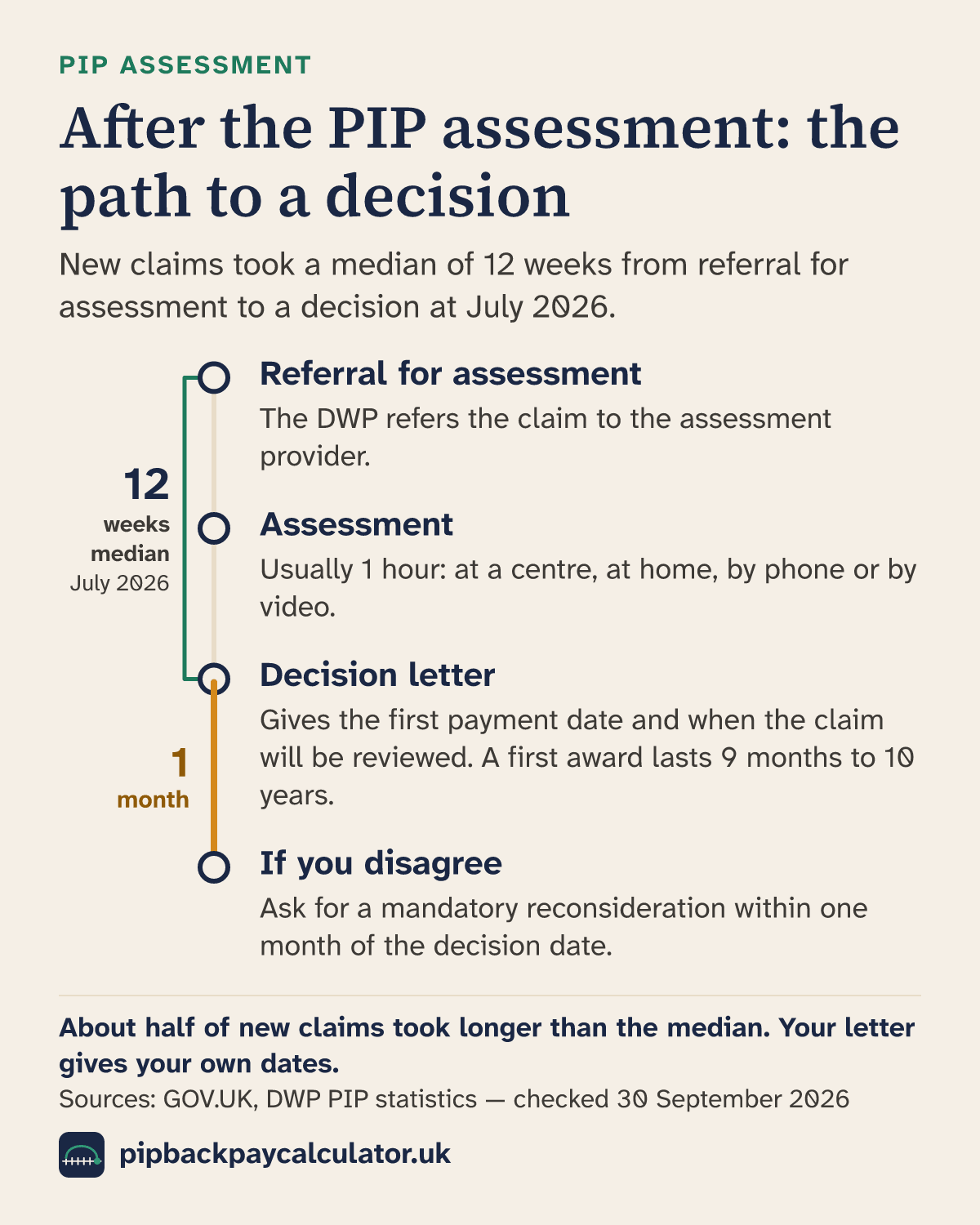
A new PIP claim took a median of 12 weeks from referral for assessment to a decision at July 2026; the assessment itself usually takes 1 hour, and a first award lasts between 9 months and 10 years.
Last checked:
How Long the Wait Is
A median of 12 weeks from assessment referral to decision at July 2026. That is the DWP's own published figure for normal rules new claims, from its PIP statistics published on 15 September 2026, and the referral point sits before the appointment rather than after it. Where the assessment was recorded, you can get a copy of the recording through a text message link and compare it with the report.
| Median clearance time, normal rules new claims | July 2026 | July 2025 |
|---|---|---|
| Assessment referral to decision | 12 weeks | 10 weeks |
| Registration to decision, end to end | 18 weeks | 15 weeks |
Last checked:
Both are medians, so half of claims cleared faster, and both are longer than a year earlier. Claims moving from Disability Living Allowance run longer again: 21 weeks end to end and 14 weeks from referral at July 2026. Nothing in the wait costs money: the award is backdated to the date of the claim, so the weeks are paid as arrears. How Long a PIP Claim Takes sets out the whole sequence with the stages that make up the difference.
How will you know PIP has been decided?
GOV.UK states that you will get a letter telling you whether you will get PIP. Where PIP is awarded, the letter also gives the date of your first payment and how long until the claim is reviewed. The back payment for the waiting weeks is paid separately and can reach your bank before the letter arrives, as explained in PIP Back Pay Before the Letter Arrives. If you have heard nothing, call the PIP enquiry line on 0800 121 4433, Monday to Friday 9am to 5pm, and ask whether a decision has been made.
Last checked:
Getting the Report
Ask for a copy, and read the descriptor recommendations. The report is sometimes called the PA4. It can be requested from the DWP or from the assessment provider, and where the assessment was recorded the audio can be requested too.
Two things in it are worth checking against your own account. The first is the descriptor recommended for each activity, which shows exactly where the professional's view and yours differ. The second is the "informal observations" section, which records what was seen or heard during the appointment and sometimes drives a recommendation more than the answers did.
A report that misstates what you said is worth addressing directly in any challenge, because it is the document the decision rests on.
Reading the Decision
The letter gives an award, a period, a points breakdown and, where relevant, arrears. GOV.UK states that where you are eligible the letter also tells you "the date of your first payment" and "how long until your claim is reviewed".
Award length is set by likely change rather than by condition. GOV.UK states that "your first award will be between 9 months and 10 years, depending on whether your needs are likely to change". A short award is not a weaker award; it is a scheduled review.
If You Disagree
One month from the date of the letter to ask for a mandatory reconsideration. GOV.UK states that "you usually need to ask for mandatory reconsideration within one month of the date of the decision". That deadline is short and it starts from the letter date, not the date you read it.
The points section is what to read before deciding. It names the descriptor chosen for each of the twelve activities, and the gap between what you described and what was scored is usually visible in two or three rows rather than across the whole form. What each part of the letter means is set out on the decision letters page.
Where an award is made and backdated, the arrears follow the decision rather than the letter, and often arrive first.