
The Short Answer
PIP pays four weekly rates in 2026/27: £76.70 standard and £114.60 enhanced for the daily living component, and £30.30 standard and £80.00 enhanced for the mobility component. You can receive one component or both, so PIP pays £30.30 to £194.60 a week, tax free. The Secretary of State reviews the rates every year, and any rise applies from April. The April 2026 rise matched CPI inflation in the year to September 2025, and the ONS publishes the September 2026 figure on 21 October 2026.
Key facts
| Fact | Figure | Source | Checked |
|---|---|---|---|
| Daily living part, weekly (2026/27) | £76.70 standard, £114.60 enhanced | GOV.UK | 30 September 2026 |
| Mobility part, weekly (2026/27) | £30.30 standard, £80.00 enhanced | GOV.UK | 30 September 2026 |
| Most PIP pays a week (2026/27) | £194.60, both enhanced rates | GOV.UK | 30 September 2026 |
| Tax | Tax free | GOV.UK | 30 September 2026 |
| How the 2026/27 rise was set | 3.8%, in line with CPI in the year to September 2025 | UK Parliament | 30 September 2026 |
| September 2026 CPI published | 21 October 2026 | ONS | 30 September 2026 |
How Much Is PIP Per Week?
The four current amounts are £76.70, £114.60, £30.30 and £80.00 a week, and every PIP award is built from them. Which of the four you receive decides your payment, and the weeks an award covers decide any PIP back pay owed on top. Every weekly rate since PIP began in 2013, with the official source for each year, is set out in PIP Rates by Year. The full table, weekly and 4-weekly:
| Component and rate | Weekly amount | Every 4 weeks |
|---|---|---|
| Daily living, standard | £76.70 | £306.80 |
| Daily living, enhanced | £114.60 | £458.40 |
| Mobility, standard | £30.30 | £121.20 |
| Mobility, enhanced | £80.00 | £320.00 |
Last checked:
Daily living component
Standard rate
£76.70 a week
- every 4 weeks
- £306.80
- a month on average
- £332.37
- a year
- £3,988.40
Enhanced rate
£114.60 a week
- every 4 weeks
- £458.40
- a month on average
- £496.60
- a year
- £5,959.20
Mobility component
Standard rate
£30.30 a week
- every 4 weeks
- £121.20
- a month on average
- £131.30
- a year
- £1,575.60
Enhanced rate
£80.00 a week
- every 4 weeks
- £320.00
- a month on average
- £346.67
- a year
- £4,160.00
Both components at the enhanced rate
- a week
- £194.60
- every 4 weeks
- £778.40
- a month on average
- £843.27
- a year
- £10,119.20
PIP is paid every 4 weeks, so a year holds 13 payments; the monthly figure spreads 52 weeks across 12 months. Rates for 2026/27 apply from April 2026.
Last checked:
Source: GOV.UK, PIP: how much you'll get (2026/27 rates)
Two facts frame the table before anything else uses it. The rates are national, identical in every English and Welsh region, with Scotland's Adult Disability Payment published separately by Social Security Scotland (see ADP rates). And the rates are net of nothing: PIP is tax free and unaffected by income, so the figures above are the amounts that actually arrive.
The components combine. Both enhanced rates together pay £194.60 a week; both standard rates together pay £107.00. Each component is examined in its own guide: Daily Living Component Rates covers the ten daily living activities behind the first two rates, and mobility follows the same pattern with two activities.
Because each component takes one of three states, none, standard or enhanced, a PIP award has eight paying combinations, and seeing them priced answers the how-much question for every possible letter:
| Award combination | Weekly total | Every 4 weeks |
|---|---|---|
| Mobility standard only | £30.30 | £121.20 |
| Daily living standard only | £76.70 | £306.80 |
| Mobility enhanced only | £80.00 | £320.00 |
| Both standard | £107.00 | £428.00 |
| Daily living std + mobility enh | £156.70 | £626.80 |
| Daily living enhanced only | £114.60 | £458.40 |
| Daily living enh + mobility std | £144.90 | £579.60 |
| Both enhanced | £194.60 | £778.40 |
Last checked:
The combination table also holds for mental health awards, arthritis awards and every other condition: the diagnosis never changes the rates, only the points behind them.
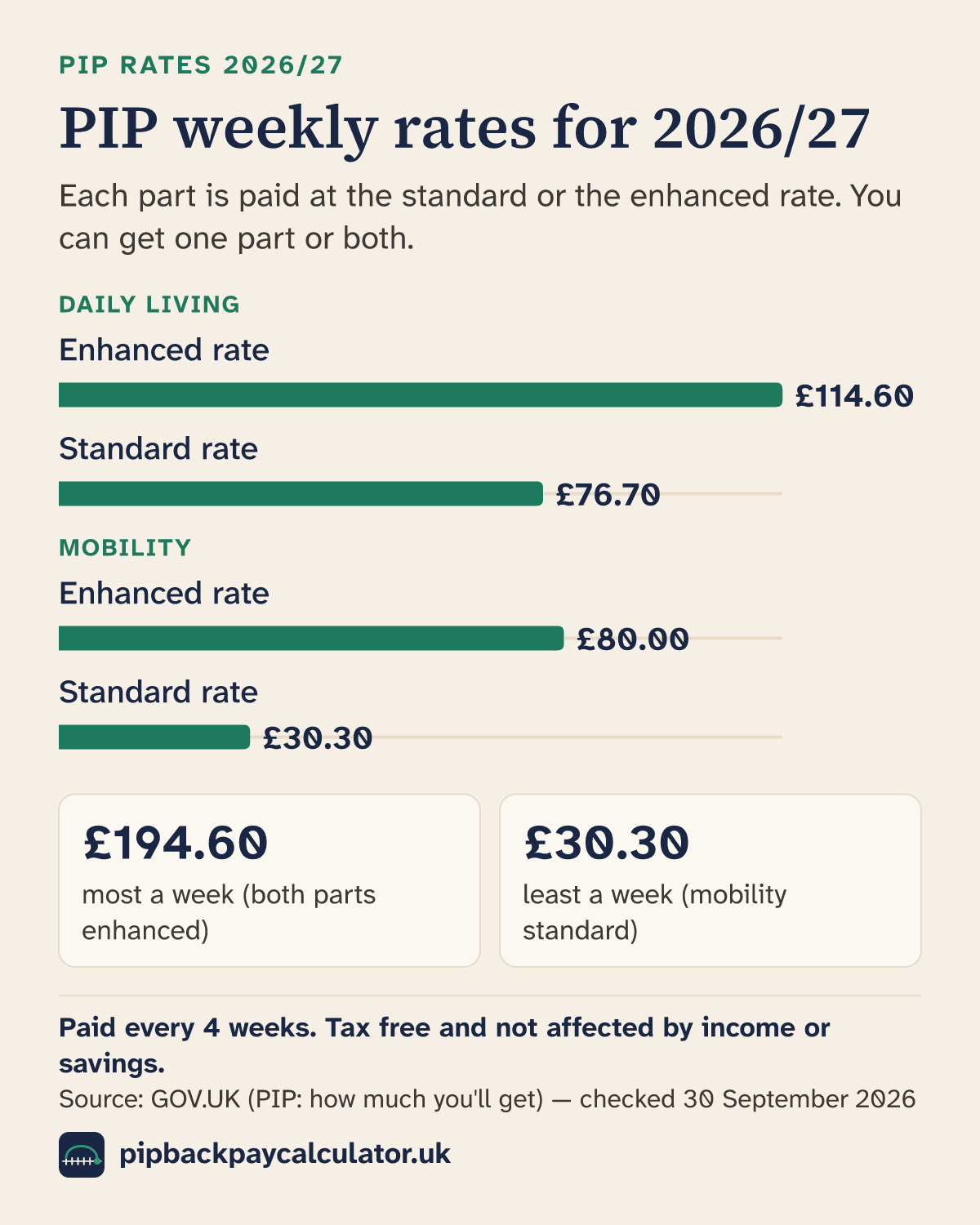
In 2026/27 PIP pays £76.70 or £114.60 a week for daily living and £30.30 or £80.00 a week for mobility, so an award is worth between £30.30 and £194.60 a week.
Last checked:
From Weekly Rate to 4-Weekly Payment
PIP is paid every 4 weeks rather than calendar monthly, so in 2026/27 one payment is between £121.20 and £778.40. A year holds 13 payments, which lifts the calendar-month average slightly above one payment; every award's monthly figure is set out in How Much PIP Is Per Month.
Last checked:
Standard vs Enhanced Rate
Your points decide the rate: at least 8 points in a component pays the standard rate, and at least 12 points pays the enhanced rate. The thresholds come from the PIP Regulations and apply to each component separately, so standard daily living alongside enhanced mobility is a normal award. Scores below 8 points pay nothing for that component.
| Points in a component | Daily living | Mobility |
|---|---|---|
| 0 to 7 | No award | No award |
| 8 to 11 | £76.70 (standard) | £30.30 (standard) |
| 12 or more | £114.60 (enhanced) | £80.00 (enhanced) |
Last checked:
What standard and enhanced mean in practice, and the points profiles that produce each award, are covered in Standard Rate PIP and Enhanced Rate PIP. Awards for mental health conditions follow exactly the same table, explored in PIP Rates for Mental Health.
When Rates Change
PIP rates change once a year, in April, after the Secretary of State's annual review of benefit rates. The 2026/27 amounts took effect in April 2026. The government raised them by 3.8%, in line with the consumer prices index (CPI) in the year to September 2025, so daily living rose by £2.80 standard and £4.20 enhanced, and mobility by £1.10 standard and £2.95 enhanced. The Secretary of State announced those rates in a written statement to Parliament on 26 November 2025.
Last checked:
How much will PIP go up in April 2027?
The 2027/28 PIP rates have not been published yet, so there is no official April 2027 figure. The increase follows a fixed legal process. Section 150 of the Social Security Administration Act 1992 requires the Secretary of State to review PIP rates in each tax year against the general level of prices. Where prices have risen, PIP must go up by at least the same percentage. The Secretary of State decides how prices are measured. For the April 2026 rise the measure was CPI in the 12 months to September 2025, which was 3.8%. If the same measure is used again, the April 2027 rise depends on CPI in the 12 months to September 2026, which the ONS publishes on 21 October 2026. Any new rates apply from April 2027.
| Weekly rate | 2026/27 (now) | 2027/28 (from April 2027) |
|---|---|---|
| Daily living, standard | £76.70 | Not yet published |
| Daily living, enhanced | £114.60 | Not yet published |
| Mobility, standard | £30.30 | Not yet published |
| Mobility, enhanced | £80.00 | Not yet published |
Last checked:
The 2027/28 column will be completed when the DWP publishes the new rates. This page shows no forecast before then, because only the up-rating order sets the figures.
Uprating applies automatically. You do not reapply, and your award letter is not reissued for a rate change; the new amount simply appears in the first affected payment. The mechanism behind the annual increase is covered in PIP Uprating, with a tool to preview your new amount at PIP Uprating Calculator.
The recent rate history
Five years of published rates show the uprating pattern at work, and they matter beyond curiosity: arrears price each week at its own year's figures. The full weekly table:
| Year | Daily living std | Daily living enh | Mobility std | Mobility enh |
|---|---|---|---|---|
| 2022/23 | £61.85 | £92.40 | £24.45 | £64.50 |
| 2023/24 | £68.10 | £101.75 | £26.90 | £71.00 |
| 2024/25 | £72.65 | £108.55 | £28.70 | £75.75 |
| 2025/26 | £73.90 | £110.40 | £29.20 | £77.05 |
| 2026/27 | £76.70 | £114.60 | £30.30 | £80.00 |
Last checked:
The table reads two useful ways. Down a column, it shows how a component's value has grown: standard daily living has risen £14.85 a week since 2022/23. Across a row, it prices any historical week inside a back-pay window, which is exactly how the calculator uses it.
Rates, awards and what they do not depend on
The four rates are national and unconditional once awarded. They do not vary by region, age within the eligible range, condition, work status, income or savings. Two claimants with the same points receive the same money in Cornwall and in Cumbria. The only variables are the two that built the table: which descriptors you satisfy, and which benefit year the week falls in.
PIP's rates also sit outside the tax and benefits interactions that complicate other income. The payments are tax free, ignored as income for means-tested benefits, and paid on top of most other support rather than instead of it. What a PIP award additionally opens, from premiums to travel support, belongs to its own guides.
Reading a rates question against this page
Every phrasing of the rates question resolves against one of the tables above, and mapping the common ones saves a search each. What are the PIP rates for 2026: the four-figure table at the top. How much is that per month: the 4-weekly column, thirteen times a year. What will my award pay: the combination table, row matching your letter. What did last year pay: the history table, one row up. What will next April pay: not published yet; the September CPI figure arrives on 21 October 2026, and the confirmed rates follow the Secretary of State's review.
The one question no rates table answers is which row you belong in, because that is the points system's job. Rates are the price list; points are the purchase. Anyone unsure of their row gets a better answer from ten minutes with the points calculator than from any amount of rate reading, and the two tools together close the question completely.
Rates on this page are checked against GOV.UK and the DWP publications on the date stamped below each table, and the entire set regenerates from those sources at each April uprating, so the figures cannot drift between checks.
Work Out Your Own Award
Two tools turn the tables above into your own figure. The PIP Rates Calculator converts an award you already know into weekly, 4-weekly and yearly amounts. The PIP Points Calculator works forwards from the 12 activities to the award your points could support.
Rates for Back Pay Calculations
Arrears use the rates of the year each week fell in, not today's rates. A back-pay window reaching into 2025/26 prices those weeks at £73.90 and £110.40 for daily living, and £29.20 and £77.05 for mobility. The back pay calculator holds five years of verified rates, from 2022/23 onwards, and applies each automatically to your dates.
Last checked:
The rates in context
The four figures gain meaning beside what they buy and what they sit alongside. The enhanced daily living rate, £114.60, exceeds many households' weekly energy and food gap, which is the scale of support the benefit intends. Both components together, £10,119.20 a year, arrive tax free and on top of earnings or other benefits rather than instead of them. And because the rates never vary by region or diagnosis, the tables on this page are the complete national answer: there is no better rate to find elsewhere, only a better award to establish through the points system.
Last checked:
The tables above are rebuilt from the official publications at every uprating, which is a promise about next April as much as this year: whatever the 2027/28 figures turn out to be, this page will carry them with a fresh stamp the week they publish, and the archive rows will keep pricing back-pay windows exactly as they do today.
Current, historical, combined and stamped: the whole rate card lives on this page.
Every figure above carries its verification date.