
The Short Answer
You need at least 8 points for the standard rate of a PIP component and at least 12 points for the enhanced rate. The thresholds come from regulations 5 and 6 of the PIP Regulations 2013 and apply to each component separately: 10 activities score daily living, 2 score mobility, and your highest applicable descriptor in each activity counts towards the total.
How many points do you need for PIP?
8 points reaches standard, 12 reaches enhanced, and anything below 8 in a component pays nothing for it. The points come from the descriptor tables in all 12 PIP descriptors, and the full matrix of outcomes:
| Points in the component | Daily living pays | Mobility pays |
|---|---|---|
| 0 to 7 | Nothing | Nothing |
| 8 to 11 | £76.70 a week (standard) | £30.30 a week (standard) |
| 12 or more | £114.60 a week (enhanced) | £80.00 a week (enhanced) |
Last checked:
Daily living component (10 activities, scored separately)
- 0 to 7 points
- No award
- 8 to 11
- Standard £76.70
- 12 or more
- Enhanced £114.60
Mobility component (2 activities, scored separately)
- 0 to 7 points
- No award
- 8 to 11
- Standard £30.30
- 12 or more
- Enhanced £80.00
Weekly amounts, 2026/27. Only the highest descriptor in each activity counts; points from different activities in the same component add together, and daily living and mobility points never combine.
Last checked:
Source: PIP Regulations 2013, regulations 5 and 6 (legislation.gov.uk); GOV.UK PIP rates
What each rate pays and the score profiles behind it are covered in Standard Rate PIP and on the enhanced rate page. No condition carries preset points: condition guides such as PIP for Osteoarthritis and PIP for Anxiety show which activities each condition commonly affects.
Can both components qualify at once?
Any award needs one component at 8 or more points, and both components can qualify at once. The combinations are independent: 8 daily living points with 12 mobility points pays standard daily living plus enhanced mobility, £156.70 a week at 2026/27 rates.
Last checked:
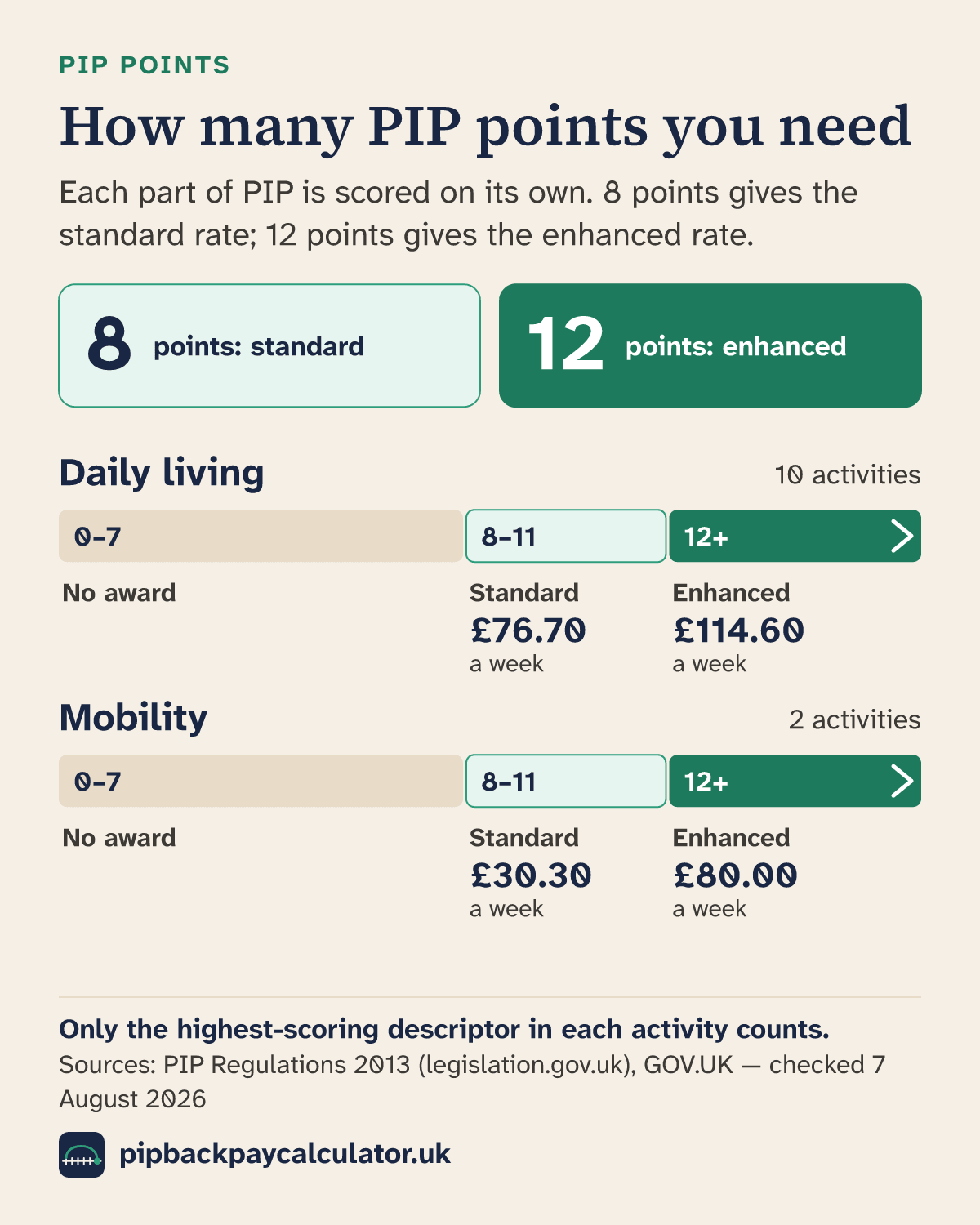
Each PIP part is scored separately: 8 points gives the standard rate and 12 points the enhanced rate, worth £76.70 or £114.60 a week for daily living and £30.30 or £80.00 for mobility in 2026/27.
Last checked:
Do you need to have difficulty every day?
No: a descriptor applies if it applies on more than 50% of the days in the required period, under regulation 7 of the PIP Regulations 2013. GOV.UK puts the same rule as expecting to have difficulty more than half of the days over a 12-month period. A difficulty that comes and goes counts on the days it happens, which is why a log of good and bad days is the evidence that shows the pattern. Each descriptor is also tested against reliability, set by regulation 4: an activity counts as done only where you can do it safely, to an acceptable standard, repeatedly and within a reasonable time.
Points Thresholds in Detail
Three scoring rules turn descriptor answers into the totals the matrix reads. Only the highest descriptor you satisfy in an activity counts, so difficulties within one activity never stack. Points from different activities in the same component add together, so four 2-point activities reach the standard rate. And every descriptor is tested against reliability: an activity you cannot do safely, to an acceptable standard, repeatedly and in reasonable time scores as if you cannot do it.
The distribution of high-value descriptors matters for the enhanced rates. Daily living reaches 12 points through breadth, since only communicating verbally carries a 12-point descriptor. Mobility reaches 12 through a single activity more often, because both mobility activities carry 12-point descriptors.
Four descriptors score 12 points on their own: one in communicating verbally, one in planning and following journeys, and two in moving around. Summarised from Schedule 1 of the PIP Regulations 2013:
- Communicating verbally: cannot express or understand verbal information at all, even with communication support.
- Planning and following journeys: cannot follow the route of a familiar journey without another person, an assistance dog or an orientation aid.
- Moving around: can stand and then move more than 1 metre but no more than 20 metres, aided or unaided.
- Moving around: cannot, aided or unaided, stand or move more than 1 metre.
The highest descriptor in each of the 12 activities:
Daily living activities
1. Preparing food
8 points2. Taking nutrition
10 points3. Managing therapy or monitoring a health condition
8 points4. Washing and bathing
8 points5. Managing toilet needs or incontinence
8 points6. Dressing and undressing
8 points7. Communicating verbally
12 points8. Reading and understanding signs, symbols and words
8 points9. Engaging with other people face to face
8 points10. Making budgeting decisions
6 points
Mobility activities
1. Planning and following journeys
12 points2. Moving around
12 points
Bars show the highest-scoring descriptor in each activity. Lines mark 8 points (standard rate) and 12 points (enhanced rate) for the component.
Last checked:
Source: PIP Regulations 2013, Schedule 1 (legislation.gov.uk)
Points convert to money at the current PIP rates, and an award reaching back over waiting months multiplies those weekly figures into arrears.
Routes to 8 and routes to 12
Worked score profiles make the thresholds concrete. A daily living standard award commonly assembles from breadth: 2 points each for aids in preparing food, washing, dressing and toilet needs reaches exactly 8. A daily living enhanced award needs heavier descriptors alongside the breadth: supervision or assistance to cook (4 points), assistance with toilet needs (4), assistance washing below the waist (2) and assistance dressing the lower body (2) reaches exactly 12. On mobility, descriptor c in moving around alone reaches standard with 8, and descriptors d, e or f reach 10 or 12 on their own.
Near-miss profiles matter just as much. Totals of 6 or 7 points in a component are the commonest painful outcomes, and they often trace to one under-scored descriptor rather than a hopeless claim. The difference between needing prompting to wash, at 2 points, and needing assistance below the waist, also 2, versus assistance in and out of the shower at 3, is exactly the kind of margin the reliability rules decide.
Points questions the thresholds answer quickly
The threshold matrix settles a family of recurring questions in one line each. No points total pays both components together; each stands alone. No award exists between 8 and 12 beyond the standard rate; 11 points pays the same as 8. Points do not carry over between reviews; each decision rescores from evidence. And no condition starts with points on the board, because every score is built descriptor by descriptor, as the all 12 PIP descriptors reference sets out in full.
The thresholds have not changed since PIP began in 2013, which makes them the stable landmark in a system where rates move every April. Money attached to the thresholds does change: crossing 8 daily living points was worth less each week in earlier years than the £76.70 it earns now, and arrears calculations respect each year's own figure. Points decide the band; the benefit year decides the price of the band.
Last checked:
The thresholds reward one final reframing: 8 and 12 are not scores to chase but descriptions to match. The claimants who reach them are the ones whose forms and answers described their days completely.
Eight and twelve: two numbers, checked in minutes, worth up to £194.60 a week.
Both thresholds sit behind every decision letter, and this page puts them in front of you.
Work Out Your Number
The thresholds are two numbers; your points are the real question. Answer the 12 activities and watch the totals cross them: work out your points thresholds position with the PIP points calculator.