
The Short Answer
To find your next PIP payment date, add 28 days to your last payment date; a date that falls on a bank holiday is normally paid the working day before. GOV.UK states that PIP is usually paid every 4 weeks, and that a payment due on a bank holiday is usually made before it, then as normal. The cycle runs from the original due dates, so an early payment does not pull the next one forward. The checker above projects 12 dates from one date you already know.
How the PIP Payment Cycle Works
Every 4 weeks, on the same weekday, in arrears. GOV.UK states that PIP "is usually paid every 4 weeks" and that your decision letter tells you "what day of the week you'll usually be paid". Because 4 weeks is 28 days rather than a calendar month, the date moves earlier through the month each time and produces 13 payments in a year.
That is why a monthly date is the wrong mental model. A payment on 3 January is followed by one on 31 January, then 28 February, and so on. The When Is PIP Paid? Payment Days Explained page sets out the cycle and what the decision letter contains.
Example cycle: payment day Monday, first due date in the year Monday 6 April 2026, England and Wales bank holidays. Your own dates depend on the day in your decision letter.
April 2026
- Thu 2 (paid early for a bank holiday)
May 2026
- Fri 1 (paid early for a bank holiday)
June 2026
- Mon 1
- Mon 29
July 2026
- Mon 27
August 2026
- Mon 24
September 2026
- Mon 21
October 2026
- Mon 19
November 2026
- Mon 16
December 2026
- Mon 14
January 2027
- Mon 11
February 2027
- Mon 8
March 2027
- Mon 8
- Due Monday 6 April 2026 (Easter Monday), normally paid Thursday 2 April 2026.
- Due Monday 4 May 2026 (Early May bank holiday), normally paid Friday 1 May 2026.
Last checked:
Source: GOV.UK bank holidays feed; GOV.UK, PIP: how much you'll get
The Bank Holiday Rule
A payment due on a bank holiday is normally made before it, and the cycle continues unchanged. GOV.UK states: "If your payment date is on a bank holiday, you'll usually be paid before the bank holiday. After that you'll continue to get paid as normal."
| Bank holiday | Payment due | Normally paid |
|---|---|---|
| Easter Monday | Mon 6 AprMon 6 Apr 2026 | Thu 2 AprThu 2 Apr 20264 days early |
| Early May bank holiday | Mon 4 MayMon 4 May 2026 | Fri 1 MayFri 1 May 20263 days early |
| Spring bank holiday | Mon 25 MayMon 25 May 2026 | Fri 22 MayFri 22 May 20263 days early |
| Summer bank holiday | Mon 31 AugMon 31 Aug 2026 | Fri 28 AugFri 28 Aug 20263 days early |
| Christmas Day | Fri 25 DecFri 25 Dec 2026 | Thu 24 DecThu 24 Dec 20261 day early |
| Boxing Day | Mon 28 DecMon 28 Dec 2026 | Thu 24 DecThu 24 Dec 20264 days early |
| New Year’s Day | Fri 1 JanFri 1 Jan 2027 | Thu 31 DecThu 31 Dec 20261 day early |
| Good Friday | Fri 26 MarFri 26 Mar 2027 | Thu 25 MarThu 25 Mar 20271 day early |
| Easter Monday | Mon 29 MarMon 29 Mar 2027 | Thu 25 MarThu 25 Mar 20274 days early |
Weekend closures before a holiday are counted, which is why a Monday holiday moves a payment back to the Friday. The following payment is still due 28 days after the original date.
Last checked:
Source: GOV.UK bank holidays feed; GOV.UK, PIP: how much you'll get
Two consequences follow. The first is that an early payment is not an extra payment; the money covers the same 4 weeks it always did, and the next payment is not late for arriving 4 weeks after the original date. The second is that the gap between an early payment and the next one is longer than 4 weeks, which is worth planning for at Christmas, when several closures fall together.
Why the Nations Differ
England and Wales, Scotland and Northern Ireland keep different bank holiday calendars. Scotland has 2 January and observes St Andrew's Day; Northern Ireland has St Patrick's Day and the Battle of the Boyne; England and Wales have neither. The same payment date can therefore be early in one nation and ordinary in another.
The checker asks where you live for that reason. PIP itself is paid in England and Wales, and by Northern Ireland's own department in Northern Ireland, but a PIP award continues for 13 weeks after a move to Scotland, so all three calendars can apply.
| Situation | What happens to the date |
|---|---|
| Ordinary cycle | Paid every 4 weeks in arrears, on a fixed weekday |
| Payment date on a bank holiday | Usually paid before the bank holiday, then as normal |
| The following payment | Still 4 weeks after the original due date, not the date paid |
| First payment after a decision | Often longer than 4 weeks, because arrears are included |
Last checked:
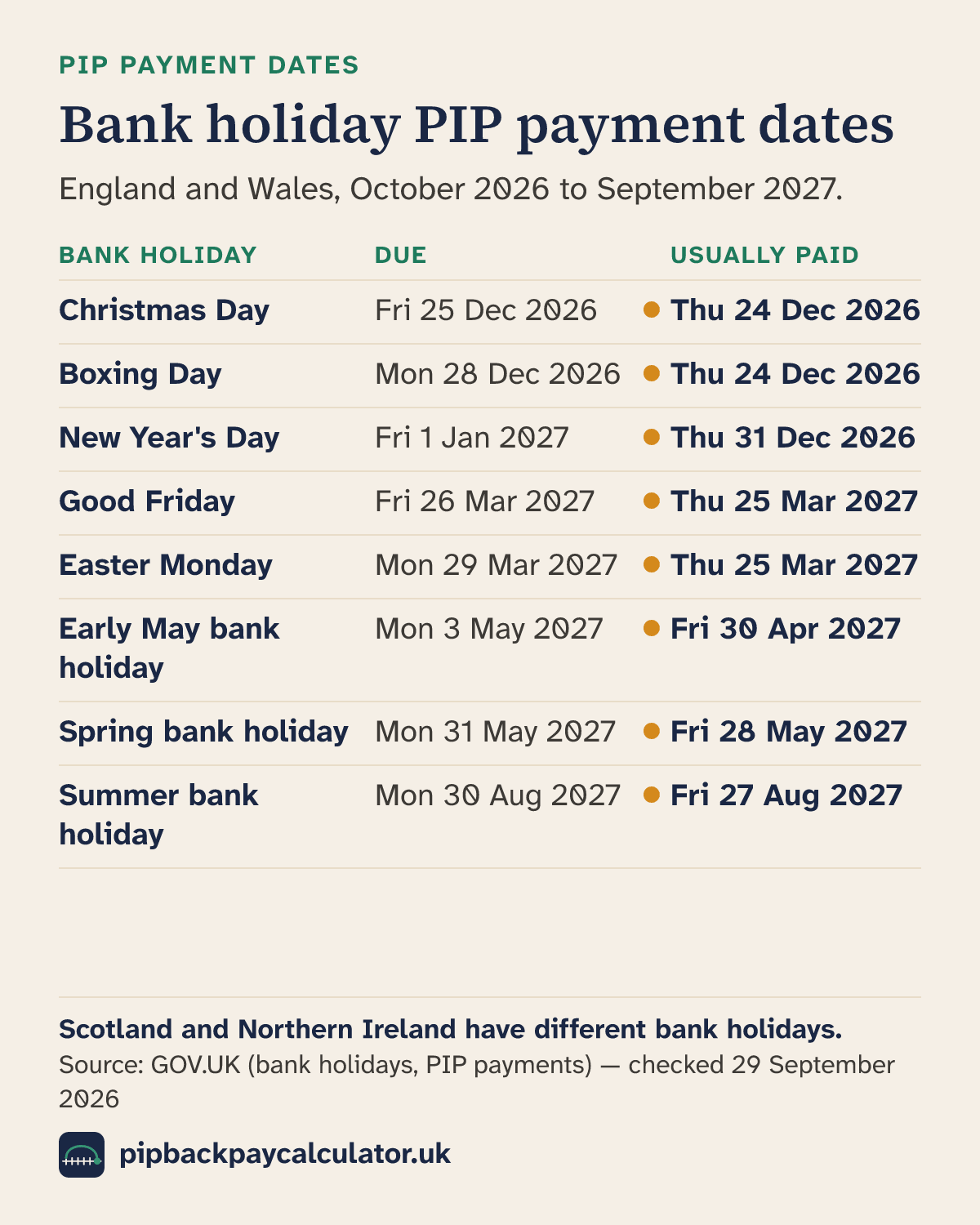
In England and Wales from October 2026 to September 2027, a PIP payment due on a bank holiday usually arrives on the last working day before it, for example Thursday 24 December 2026 for a payment due on 25 December 2026.
Last checked:
When a Payment Does Not Arrive
Allow a few working days past the date shown before treating a payment as missing. Bank processing sits between the DWP issuing a payment and the money appearing, and no calendar predicts it. Three checks settle almost every case:
- Confirm the due date against your decision letter, counting 28 days from the last payment rather than a calendar month.
- Check whether the due date was a bank holiday, in which case the money arrived earlier and the following gap is longer than 28 days.
- Check the account named in the decision letter, which is not always the account you use most.
Where the money still has not arrived, the PIP enquiry line on 0800 121 4433 (Monday to Friday, 9am to 5pm) can confirm the date it was issued and the account it went to. Those two facts separate a DWP problem from a bank problem, and each has a different next step, set out in PIP Payment Late or Missing. A new award follows its own opening sequence before the 28-day rhythm starts, covered in Your First PIP Payment.
Last checked:
Check Your Own Calendar
The checker above works from one date you already have. Two pages carry the rest:
- The published calendar for the current benefit year is on the PIP Payment Dates 2026/27 page.
- The rule for early payments, with the dates it applies to, is set out on the bank holidays page.