
The Short Answer
PIP (Personal Independence Payment) is a UK benefit that helps with extra living costs if you have both a long-term physical or mental health condition or disability and difficulty doing certain everyday tasks or getting around. It has two parts, daily living and mobility, paying £30.30 to £194.60 a week in 2026/27. PIP is tax free, is not means tested, and does not depend on your work status.
What is PIP?
Personal Independence Payment is the working-age disability benefit for England and Wales, paid by the Department for Work and Pensions. It replaced Disability Living Allowance for working-age adults from 2013. Getting it starts with How to Claim PIP, and the claim leads to an assessment of how difficult you find two groups of activities. The essentials in one table:
| Attribute | PIP |
|---|---|
| Full name | Personal Independence Payment |
| Paid by | Department for Work and Pensions (DWP) |
| Parts | Daily living component and mobility component |
| Weekly amounts (2026/27) | £76.70 or £114.60 daily living; £30.30 or £80.00 mobility |
| Means tested | No. Income and savings do not affect it |
| Taxable | No |
| Payment cycle | Usually every 4 weeks, in arrears |
| Introduced | 2013, replacing DLA for working-age adults |
Last checked:
The DWP assesses how difficult you find daily living and mobility tasks, using a points system across 12 activities. Points decide everything: at least 8 in a component pays its standard rate, and at least 12 pays its enhanced rate. Each claimant is paid on their own 4-weekly day, set out in when PIP is paid.
What are the criteria for PIP?
GOV.UK sets four criteria for PIP: you are 16 or over, you have a long-term condition or disability, it makes everyday tasks or getting around difficult, and you expect the difficulties to last at least 12 months. The condition can be physical or mental, and the 12 months run from when the difficulties started. You also usually need to be under State Pension age to make a new claim, and to be living in England or Wales when you apply, having lived in England, Scotland or Wales for at least 2 of the last 3 years. Scotland has its own benefit, Adult Disability Payment.
Last checked:
Is there a list of conditions that qualify for PIP?
No: PIP has no list of qualifying conditions, of 20, 21 or any other number. The claim form asks how your condition affects you, not what it is called. Arthritis, anxiety, multiple sclerosis, diabetes and hundreds of other conditions all qualify the same way: by scoring points against the 12 activities. For example, PIP for Osteoarthritis shows how one condition maps onto those activities.
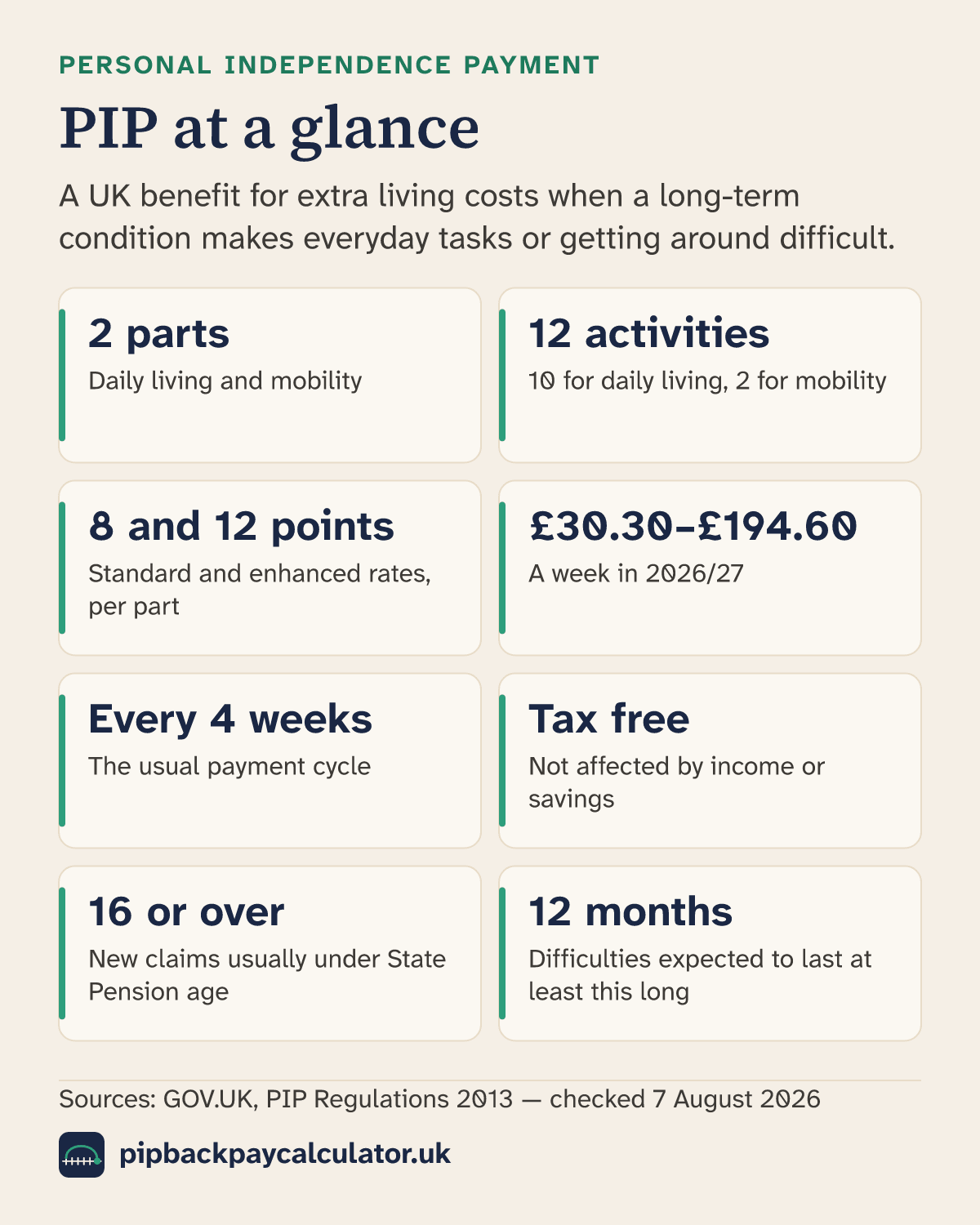
PIP has two parts, daily living and mobility, scored across 12 activities, and in 2026/27 pays £30.30 to £194.60 a week, usually every 4 weeks, tax free and whatever your income or savings.
Last checked:
PIP Definition in Detail
Three boundaries pin down what PIP is by what it is not. PIP is not means tested, so it differs from Universal Credit: earnings, savings and a partner's income leave it untouched. PIP is not an out-of-work benefit, so it differs from ESA: you can work full time and receive it. And PIP is not medical care or a diagnosis-based award: two people with the same condition can receive different awards, because the points measure difficulty, not illness.
The name causes one regular confusion. PIP the benefit shares its initials with private medical abbreviations and with payment protection insurance, and shares its territory with two successors. Scotland replaced PIP with Adult Disability Payment for new claims, and Northern Ireland runs its own PIP system. This site covers the DWP benefit for England and Wales.
Entitlement runs on three tests, each with its own depth. You must be 16 or over and usually under State Pension age. Your difficulties must be expected to last, with gov.uk's rule of thumb at least 12 months from when they started. And the difficulties must score enough points in the assessment. The full rules are set out in eligibility explained, and the money they lead to in the PIP rates tables.
Last checked:
The life of a PIP award
A PIP award has a shape as well as an amount. Getting one starts with a phone call, runs through a form and usually an assessment, and ends in a decision letter that is backdated to the call. The award then carries a length, from short fixed terms to ongoing awards with light-touch reviews, and a review date at which the DWP looks again. Payments arrive every 4 weeks throughout, rising each April with uprating.
Awards also end and change. A fixed-term award needs renewing before it expires. A change in your condition, better or worse, must be reported and can move the award either way. And a decision you disagree with, at any of these points, opens the same challenge ladder: mandatory reconsideration within one month, then an independent tribunal.
PIP's place among the disability benefits
The benefit map around PIP is small once the boundaries are drawn. Attendance Allowance covers new claims past State Pension age. Adult Disability Payment covers Scotland. Child DLA covers under-16s, whose claimants transfer to PIP at 16 in England and Wales. ESA and Universal Credit cover income and work capability, which PIP deliberately ignores. Carer's Allowance attaches to the person caring for a PIP claimant on the daily living component, not to the claimant.
One historical boundary still generates arrears cases: working-age DLA claimants moved to PIP across the 2013 to 2019 transfer years, and differences between the two awards over transfer windows are the business of the DLA back pay calculator in the tools menu.
Where PIP came from
PIP was created by the Welfare Reform Act 2012 and introduced from 2013, replacing Disability Living Allowance for working-age adults. The redesign swapped DLA's care-focused language for a points assessment across defined activities, added regular reviews, and split each component into standard and enhanced rates in place of DLA's three-rate care structure. The governing detail sits in the Social Security (Personal Independence Payment) Regulations 2013, which still define every activity, descriptor and point today, as amended over the years since.
The name itself explains the design brief: a payment supporting personal independence, tied to the extra costs of living with a disability rather than to inability to work. That founding logic is why work, income and savings never entered the rules, and why the assessment asks what you can do rather than what you earn.
What the money is for, and what it is not
PIP arrives unconditionally: no rule directs how you spend it, and no receipts are ever required. In practice it meets the costs a condition creates, from taxis and equipment to heating and paid help. It is not a diagnosis payment, not compensation, and not a wage replacement; it can be spent on anything, because the extra costs of disability take a different shape in every life.
The award also acts as a key. The daily living component can support a carer's claim for Carer's Allowance, the mobility component can open the Motability scheme and Blue Badge routes, and either component can add premiums to means-tested benefits. Those extras are covered across this site's later clusters; the point here is that a PIP award is usually worth more than its own weekly rates.
The words around PIP, decoded
A handful of terms carry the whole PIP vocabulary, and defining them once makes every letter readable. Components are the two halves of the benefit, daily living and mobility. Descriptors are the fixed statements that score each activity, lettered a onwards. The PIP2 is the claim form, formally How your disability affects you. An award is the components and rates you are given, with a length and a review date. Mandatory reconsideration is the first challenge stage, and the tribunal the second. Arrears or a back payment is the lump sum covering the wait, backdated to the claim date.
Every one of those terms has a full page or cluster on this site; this page is the hub they radiate from, which is what an entity home is for.
PIP in a claimant's year
Seen from inside a claim, PIP is less a definition than a small calendar of events. Money arrives every 4 weeks on your payment day. April brings the uprating and slightly larger payments. A review form arrives somewhere in the award's life, asking how things stand now. Changes in your condition carry a duty to report as they happen. And around each decision point, the same short deadlines recur: one month to seek reconsideration, one month from the reconsideration notice to appeal.
Holding the calendar view prevents the two commonest drifts: treating the award as permanent when it carries a review date, and treating deadlines as flexible when they are statutory. Everything else about living with PIP is quieter than the claiming process that starts it.
For anyone deciding what to do with this page, the decision tree is short. Unsure whether you qualify: read the eligibility tests. Unsure what you would score: run the points check. Waiting on a decision: price the waiting weeks with the back pay tool. Holding a letter: check its figures against the rates tables. Each next step exists on this site, one link from here.
PIP rewards understanding before applying, and this page is the understanding: two components, points not diagnosis, tax free, work safe, backdated to the claim.
One benefit, two components, twelve activities: that is PIP.
Work Out Your Number
The points system is the whole engine of PIP, and you can run it yourself. Score the 12 activities with the PIP Points Calculator and see the award your answers could support.