
The Short Answer
PIP is usually paid every 4 weeks, in arrears, on a weekday fixed when your claim was decided. Your decision letter tells you the date of your first payment and the day of the week you will usually be paid. There is no national PIP payday: each claimant keeps their own 4-weekly cycle. Payments due on a bank holiday usually arrive early, and everything is paid into your bank, building society or credit union account.
Your next PIP payment
Enter a payment date you know to see your next payment and the 12 after it.
Key facts
| Fact | Figure | Source | Checked |
|---|---|---|---|
| How often PIP is paid | Usually every 4 weeks, in arrears | GOV.UK | 30 September 2026 |
| Payment day is a bank holiday | Usually paid before the bank holiday | GOV.UK | 30 September 2026 |
| Time of day paid | No time of day is published | GOV.UK | 30 September 2026 |
| PIP enquiry line | 0800 121 4433, Monday to Friday 9am to 5pm | GOV.UK | 30 September 2026 |
When is PIP paid?
Every 4 weeks, on your own payment day, into the account you gave the DWP. The cycle starts with your award and repeats every 28 days from there. Waiting weeks before the award are settled separately as arrears, which the interactive estimate on this site works out from your dates. The full cycle at a glance:
| Payment | When it arrives | What it covers |
|---|---|---|
| Backdated lump sum | Separately, after the decision | Every week from your claim date to the decision |
| First regular payment | The date in your decision letter | The first 4 weeks of the ongoing award |
| Every later payment | Every 4 weeks, same weekday | The 4 weeks just ended (paid in arrears) |
| Bank holiday payments | Usually early, before the holiday | The normal amount, arriving sooner |
Last checked:
When is PIP paid this month?
On whatever date your own 4-weekly cycle lands this month. Because 28-day cycles drift through the calendar, your payment date moves earlier through the month over time, and some months contain two payment dates. Your last bank statement shows the pattern; the dates for the whole benefit year sit in PIP Payment Dates 2026/27.
Is PIP paid in advance or in arrears?
PIP pays in arrears: each payment covers the 4 weeks just finished, not the 4 weeks ahead. The DWP set the weekday when your claim was decided, and it stays fixed unless a bank holiday moves an individual payment. Regulation 48 of the Claims and Payments Regulations 2013 sets the 4-weekly interval in arrears, with one exception: under the terminal illness rule, PIP may be paid weekly in advance.
Weeks 1 to 4
Payment 1
day 28Weeks 5 to 8
Payment 2
day 56Weeks 9 to 12
Payment 3
day 84
- Each payment is 4 × your weekly award and arrives on the same weekday, which your decision letter names.
- A payment due on a bank holiday is usually made before it; the next one still falls 28 days after the original due date.
- The exception: where the terminal illness rule applies, PIP may be paid weekly in advance.
Last checked:
Source: Regulation 48, SI 2013/380 (legislation.gov.uk); GOV.UK, PIP: how much you'll get
How do I find my PIP payment day?
Your decision letter is the authoritative answer: it states your first payment date and your usual payment day. Lost letters are replaceable. Call the PIP enquiry line on 0800 121 4433 (Monday to Friday, 9am to 5pm) with your National Insurance number, and ask for your payment details.
Last checked:
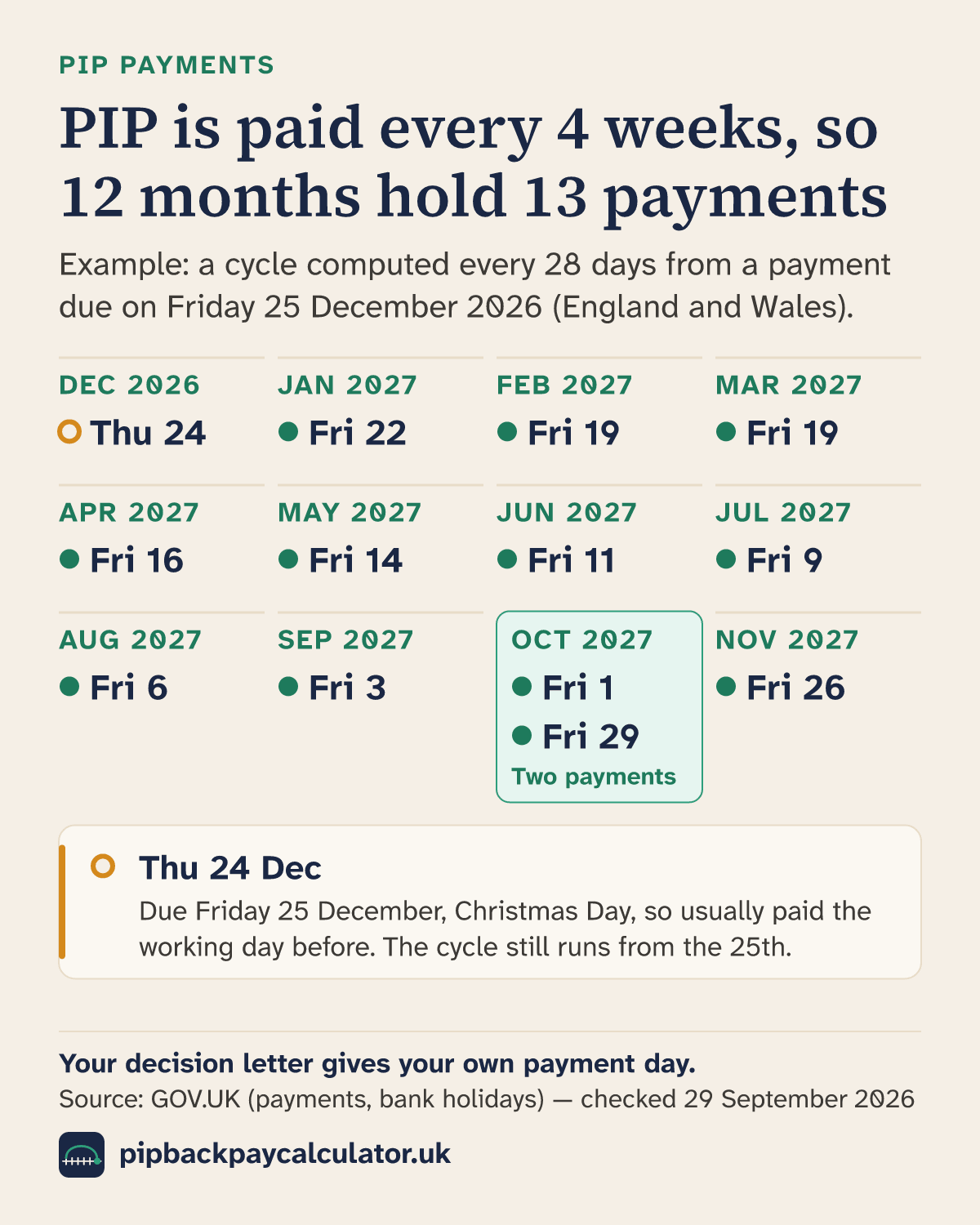
PIP is usually paid every 4 weeks on the same weekday, so 12 months hold 13 payments, and a payment due on a bank holiday such as 25 December 2026 usually arrives the working day before.
Last checked:
What time does PIP go into your bank account?
The DWP does not publish a time of day for PIP payments: the money is paid on your due date, and the time it shows depends on your bank. GOV.UK states that benefits are usually paid straight into your bank, building society or credit union account, and that a payment due on a weekend or bank holiday is usually made on the working day before. Some banks show the credit early in the morning and others later in the day. If nothing has arrived by the end of your due day, check the date against your letter and the holiday table below, then follow the steps in PIP Payment Late or Missing.
Last checked:
Payment Schedule in Detail
Two rules generate every date in your PIP payment history: every 28 days, and early when a holiday intervenes. The first payment anchor is the decision date. From it, payments repeat like clockwork through the year, 13 times across 52 weeks.
Example cycle: payment day Monday, first due date in the year Monday 6 April 2026, England and Wales bank holidays. Your own dates depend on the day in your decision letter.
April 2026
- Thu 2 (paid early for a bank holiday)
May 2026
- Fri 1 (paid early for a bank holiday)
June 2026
- Mon 1
- Mon 29
July 2026
- Mon 27
August 2026
- Mon 24
September 2026
- Mon 21
October 2026
- Mon 19
November 2026
- Mon 16
December 2026
- Mon 14
January 2027
- Mon 11
February 2027
- Mon 8
March 2027
- Mon 8
- Due Monday 6 April 2026 (Easter Monday), normally paid Thursday 2 April 2026.
- Due Monday 4 May 2026 (Early May bank holiday), normally paid Friday 1 May 2026.
Last checked:
Source: GOV.UK bank holidays feed; GOV.UK, PIP: how much you'll get
Bank holidays are the one scheduled interruption. Where your date falls on one, payment usually arrives the working day before, then the cycle continues unshifted. The remaining England and Wales holidays this benefit year are 25 and 28 December 2026, 1 January 2027, and 26 and 29 March 2027, with Christmas the season most likely to move a PIP date. The table below applies the GOV.UK rule to each of them, and seasonal specifics live in PIP Christmas Payments and the Christmas Bonus.
| Bank holiday | Payment due | Normally paid |
|---|---|---|
| Easter Monday | Mon 6 AprMon 6 Apr 2026 | Thu 2 AprThu 2 Apr 20264 days early |
| Early May bank holiday | Mon 4 MayMon 4 May 2026 | Fri 1 MayFri 1 May 20263 days early |
| Spring bank holiday | Mon 25 MayMon 25 May 2026 | Fri 22 MayFri 22 May 20263 days early |
| Summer bank holiday | Mon 31 AugMon 31 Aug 2026 | Fri 28 AugFri 28 Aug 20263 days early |
| Christmas Day | Fri 25 DecFri 25 Dec 2026 | Thu 24 DecThu 24 Dec 20261 day early |
| Boxing Day | Mon 28 DecMon 28 Dec 2026 | Thu 24 DecThu 24 Dec 20264 days early |
| New Year’s Day | Fri 1 JanFri 1 Jan 2027 | Thu 31 DecThu 31 Dec 20261 day early |
| Good Friday | Fri 26 MarFri 26 Mar 2027 | Thu 25 MarThu 25 Mar 20271 day early |
| Easter Monday | Mon 29 MarMon 29 Mar 2027 | Thu 25 MarThu 25 Mar 20274 days early |
Weekend closures before a holiday are counted, which is why a Monday holiday moves a payment back to the Friday. The following payment is still due 28 days after the original date.
Last checked:
Source: GOV.UK bank holidays feed; GOV.UK, PIP: how much you'll get
A payment that misses its expected day without a holiday explanation is worth chasing the same week. New claimants watching for their opening payments will find the first-payment sequence in Your First PIP Payment, and the mechanics of accounts and payment methods in How PIP Is Paid.
The cycle never changes the amounts. Each payment is 4 × your weekly award at the current rates, and April uprating flows into the first payment covering the new year's weeks.
Finding your payment day without the letter
Three routes recover a forgotten payment day, in rising order of effort. Your bank statement shows the pattern directly: find two DWP PIP credits and the day of the week they share. The decision letter states the day explicitly, and a replacement is available from the enquiry line. And the enquiry line itself can read your next payment date from the claim record while you are on the call.
The day itself carries no meaning. Unlike some benefits, PIP paydays are not derived from your National Insurance number; the day simply falls out of when your claim was decided. No day is faster, safer or better than another, and the DWP does not offer day changes for convenience.
First payments and changed payments
A new award opens with an irregular beat before the rhythm settles: the arrears lump sum lands first, then the first regular payment on the letter's date, then the clean 28-day cycle. An award changed mid-cycle keeps its day, with the new amount appearing from the first payment after the change and any difference for past weeks arriving separately.
The rare disruptions are worth naming because they are rare. A change of bank account moves payments only after you report it to the enquiry line. A missed payment with no holiday in the table above is a fault, not a schedule feature, and a same-week call resolves most of them. Scotland's Adult Disability Payment runs its own cycle under Social Security Scotland, so a transfer north replaces this page's rules entirely.
Accounts, absences and the edges of the schedule
Payment lands in the bank, building society or credit union account your claim named, per gov.uk, and changing it is an enquiry-line call made well before the next due date. Joint accounts are acceptable; payments to a third party run through appointee arrangements rather than informal redirection.
Absence abroad has a reporting line built into the rules: going abroad for more than 4 weeks is on the DWP's must-report list, because extended absence can affect the award itself, not just its delivery. Hospital and care home stays sit on the same list for the same reason. Reporting protects you twice over, keeping payments correct and preventing recoverable overpayments from building silently.
Last checked:
The schedule's edges are otherwise undramatic by design: no seasonal variation beyond the holiday table, no differences by region or bank, and no action needed from you in an ordinary year beyond keeping the account details current.
One rhythm question recurs enough to answer directly: why the payment covers the past rather than the future. Paying in arrears means each transfer settles the 4 weeks just lived, which is why a stopped award still produces one final payment, and why the first payment after an award can feel late when it is exactly on time. Reading your payments as settlements rather than allowances makes every date in the cycle predictable.
Payment questions cluster into two families, and this page's tables answer both: when the cycle pays in an ordinary week, and what moves it in a holiday week. Everything else about PIP money, the amounts, the arrears and the annual rises, belongs to the rates and back pay pages, one link away throughout, and the benefit itself is defined in What Is PIP (Personal Independence Payment)?.
Once the payment day is known and the holiday table is bookmarked, PIP payments become the most predictable part of the benefit: the same amount, every 28 days, adjusted early twice a year at most.
Cycle, day, holidays: three facts, and your payment calendar is complete.
Work Out Your Number
Your payment day plus the 28-day rule produces every date in your year. Check the calendar against your own cycle: work out your payment schedule, or see PIP Payment Dates 2026/27 for this year's holiday-adjusted dates.