
The Short Answer
The maximum PIP back payment is not a fixed sum: it is the weekly award multiplied by every week from your claim date to payment, at up to £194.60 a week in 2026/27. There is no cash cap, so the length of the wait sets the total. The largest sums come from tribunal wins, because the wait is longest and the award runs from the original claim. Earlier weeks are priced at the lower rates of their own benefit years.
Key facts
| Fact | Figure | Source | Checked |
|---|---|---|---|
| Back pay runs from | The date of claim (new claims) | GOV.UK | 30 September 2026 |
| Most PIP pays a week (2026/27) | £194.60, both enhanced rates | GOV.UK | 30 September 2026 |
| Back pay and Universal Credit savings | Ignored as capital for 12 months | legislation.gov.uk | 30 September 2026 |
| Tax | Tax free | GOV.UK | 30 September 2026 |
What is the maximum back pay for PIP?
The maximum back pay for PIP is the whole of your award between the claim date and payment, with no cash cap on the total. The rules that produce this are covered in PIP back pay: every new award is backdated to the claim date, and a tribunal win restores that same date after months of challenge. The longer the road to the right decision, the larger the lump sum.
Three factors set the ceiling in practice, and only three: the weekly award decided, the length of the wait, and the rates in force across the years the wait covered. The highest weekly award, £194.60 in 2026/27 for both enhanced components, is set out with every other amount in pip rates explained.
Back pay at the highest rate by length of wait
At both enhanced rates, a wait of 13 weeks produces about £2,500 of back pay, and each further 13 weeks adds roughly the same again. The table prices waits of 13 to 104 weeks ending on 30 September 2026, with each week at its own benefit year's rate:
| Wait | Claim date | Back pay | Rate years |
|---|---|---|---|
| 13 weeks | 1 July 2026 | £2,529.80 | 2026/27 |
| 26 weeks | 1 April 2026 | £5,054.49 | 2025/26, 2026/27 |
| 39 weeks | 31 December 2025 | £7,491.34 | 2025/26, 2026/27 |
| 52 weeks | 1 October 2025 | £9,928.19 | 2025/26, 2026/27 |
| 78 weeks | 2 April 2025 | £14,799.64 | 2024/25, 2025/26, 2026/27 |
| 104 weeks | 2 October 2024 | £19,591.44 | 2024/25, 2025/26, 2026/27 |
Method: each window ends on 30 September 2026 and is priced at both enhanced rates, with every week at its own benefit year's rates and the April boundary approximated as the first Monday on or after 6 April. Estimates, not DWP decisions.
Last checked:
No back payment exceeds the award it settles: the lump sum is the same money you would have received week by week, arriving late and together. How long the payment itself takes after a decision is covered in How Long PIP Back Pay Takes to Arrive, and the tribunal route in how back pay timing works.
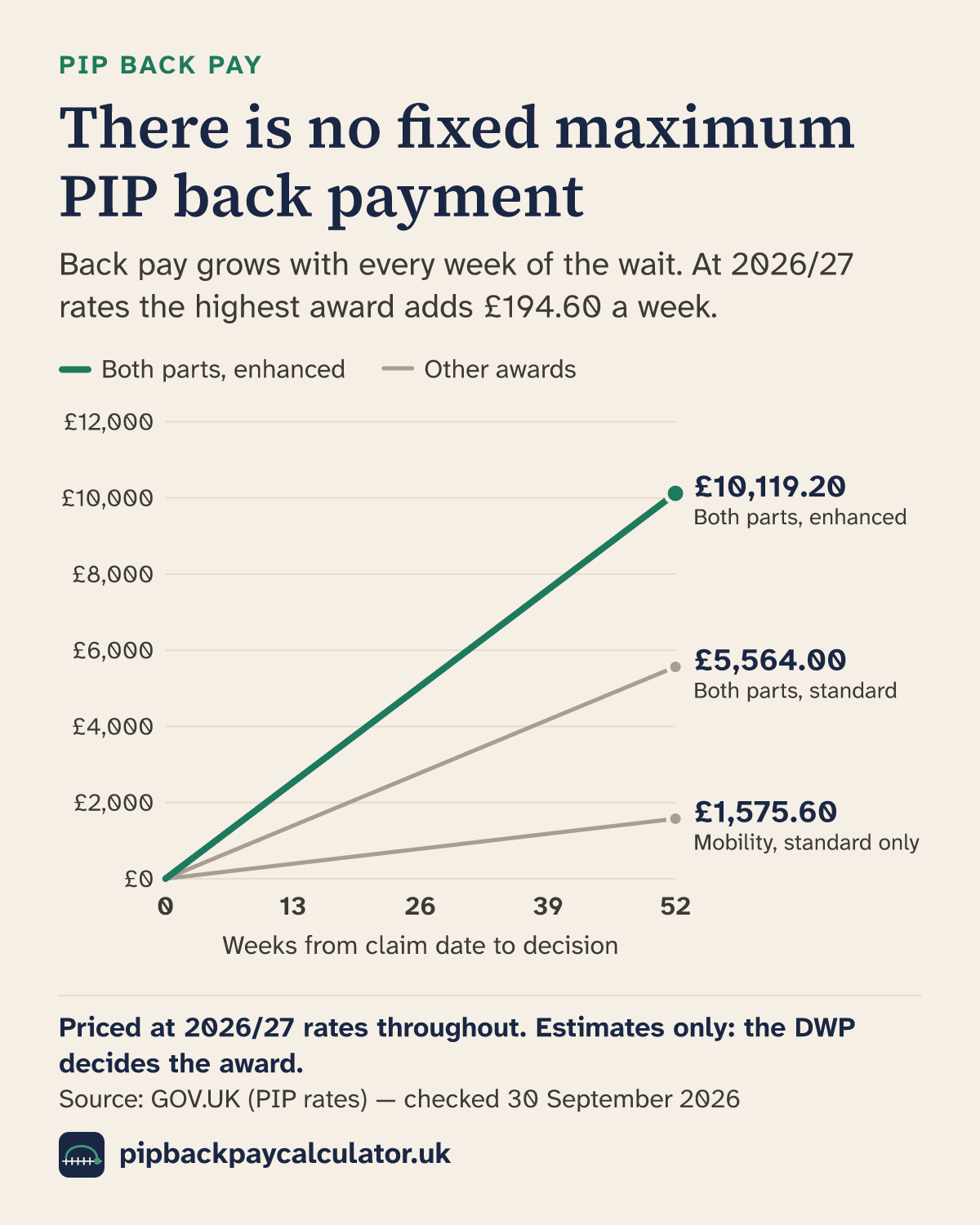
There is no fixed maximum PIP back payment: at 2026/27 rates it grows by up to £194.60 for each week of the wait, reaching £10,119.20 after 52 weeks on the highest award.
Last checked:
Back Pay Amount in Detail
Worked examples show what the time limit really produces. Each example below prices every week at the rates for its benefit year, which is how the DWP calculates back pay. Around the April boundary the exact day counts can shift a result by a few pounds.
The tribunal scenario produces the headline sums. A claimant applies on 3 June 2024, is refused, and wins both enhanced rates at tribunal on 7 December 2026, backdated to the claim.
- Claim made
- Refused
- Mandatory reconsideration
- Appeal
- Tribunal decision
Back pay starts3 June 2024date of claim
Back pay ends7 December 2026tribunal decision
131 weeks of arrears, split at each April uprating
| Benefit year | Weeks | Weekly rate | Back pay |
|---|---|---|---|
| 2024/25 | 44 weeks | £184.30 | £8,109.20 |
| 2025/26 | 52 weeks | £187.45 | £9,747.40 |
| 2026/27 | 35 weeks | £194.60 | £6,811.00 |
| Total | 131 weeks | £24,667.60 |
- After a tribunal win the lump sum normally takes 4 to 6 weeks to arrive, with regular payments at the new rate from then on.
- An estimate from published rates, not a DWP decision; the April boundary is approximated to the week the new rates apply.
Last checked:
Source: Back-pay engine using GOV.UK and DWP benefit rates by year
The table's lesson is that the years multiply, not just the weeks. A standard new claim resolves in months; a tribunal case can span three rate years, each priced at its own figures.
Two smaller scenarios complete the range. A 24-week new claim awarded standard daily living in June 2026 produces £1,804.40 of back pay across two rate years. A mandatory reconsideration that upgrades daily living from standard to enhanced over a 20-week window inside 2026/27 pays the difference of £37.90 a week, which is £758.00. The increase cases pay only the gap between old and new awards, never both amounts.
Last checked:
One rule extends the window beyond your own claim, and only one. Where the DWP revises a decision for official error, its own mistake in law or fact, the corrected award may run from the date of the original wrong decision. Past correction exercises have produced back pay reaching back years. These cases are rare, start from the DWP's side or a legal ruling, and have no deadline attached. Every ordinary route is bounded by your claim date.
What sets your own maximum
Reading the three factors against your own case turns the examples into a personal ceiling. The award level is the rate column: every week carries between £30.30 and £194.60 at 2026/27 values, and proportionally less in earlier years. The wait is the row count: count the weeks from your claim date to the decision or hearing. The rate years are the multiplier drift: each April in the window lifts the price of the weeks after it.
Last checked:
Increases have a lower ceiling than fresh awards by construction. Because an increase pays only the weekly gap between old and new awards, the largest possible increase delta in 2026/27 is £164.30 a week, from standard mobility alone to both enhanced components. Fresh awards after a refusal pay the full weekly amount, which is why tribunal reversals of outright refusals dominate the biggest sums. Before pricing a window that reaches back past April 2022, check past PIP rates for each benefit year it covers.
The ceiling question has one more honest edge: interest. The DWP pays the back pay at the nominal rates of each year, without interest for the waiting time. A two-year-old week is paid at that week's price, not today's. The uprating drift between years partially offsets this, and nothing in the standard process adds more.
Checking a maximum-sized payment
A five-figure lump sum deserves five minutes of verification. Recompute the window with your own dates, compare the per-year rows against the letter's breakdown, and query any year priced at the wrong rates through the enquiry line. Large payments spanning several years involve manual calculation steps, and manual steps occasionally misplace an April boundary. The one-month challenge window applies to the back-payment figure exactly as it does to the award itself.
Cap myths deserve one direct paragraph, because they circulate constantly. No rule limits the back payment to 12 months, to one benefit year, or to any round number; those limits belong to other benefits and to older backdating schemes. The only true boundaries are the ones this page has already named: the claim date at the start, the decision at the end, and the rare official-error cases that reach past both.
The honest summary for anyone scanning: no cap exists, your claim date is the floor, tribunal cases reach the largest sums, and every figure is checkable from the published rates in minutes with the calculator.
Large or small, every maximum on this page is an estimate until the DWP's letter confirms it, and the letter is checkable in minutes with the tools above.
Time, award and rate years: three inputs, no cap.
The calculator turns those inputs into your own ceiling.
Work Out Your Number
Your own maximum is your dates and award run through the same arithmetic as the tables above. Enter them and read the figure: work out your PIP back payment estimate.